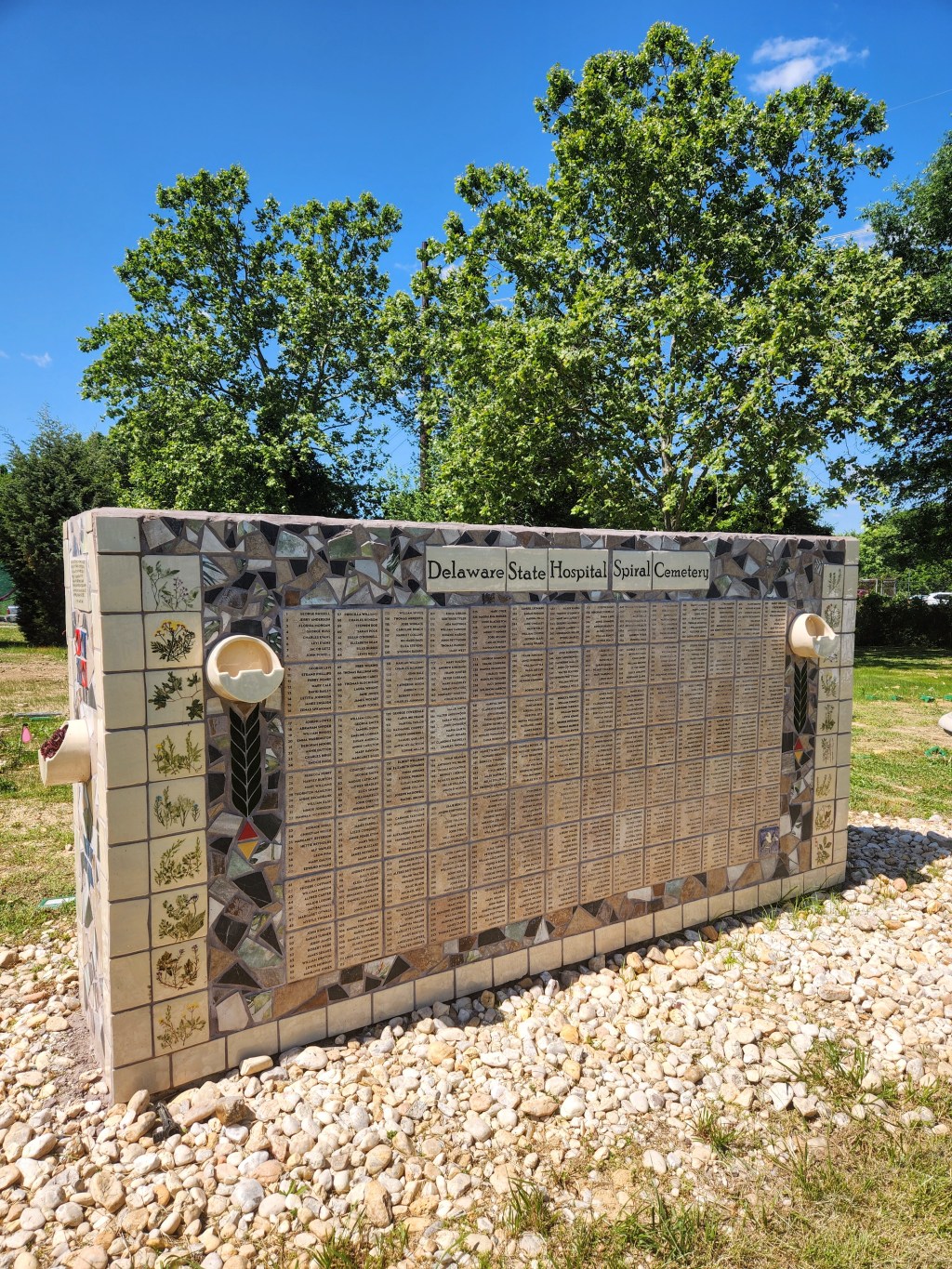
I was recently invited to attend a Day of Remembrance for the Delaware Department of Health and Social Services Cemetery. This is where folks are buried through what is called the Indigent Burial Program – people who do not have funds, family, or friends in their lives to take care of their burial. Many of them are patients and longtime residents of the adjacent state psychiatric hospital.
For the last several years, my staff and I have done a day of service to help clean up the historic Farnhurst cemetery (a.k.a. “Potter’s field”) that was used in the late 1800’s and early 1900’s for the Indigent Burial Program. Over 2000 people are buried there, but I-95 was built over (and really right through) the cemetery. The area was covered with trash and invasive plants. Most of the death records for those buried there were lost.

We spent our time at Farnhurst cutting away invasive vines, throwing away trash, mulching and planting seeds for native flowers and pollinators. We were only there for an occasional day, but several people have dedicated years of work to restoring the cemetery, and finding out who the people were who were buried there. A local artist who runs a local drop-in art center for people in recovery created a beautiful memorial, which he has been repairing and restoring for years as he learns about the art form.
Why does any of this matter?
I think it matters because people with serious mental illness are as much deserving of dignity as any other person, as much a child of God as any mentally healthy person. It reminds me and my colleagues of our mission to help everyone feel supported in recovery. It reminds us that we’ve come a long way from the days when people used to be chained up in basements because they were experiencing psychosis or mania (or because they were inconvenient to care for – people were put in asylums who did not have mental illness but perhaps had intellectual differences, unwed mothers, etc), but we still have a lot of work to do.
Our work is with the living, as it should be. But restoring some dignity to the dead is also a way of recognizing the humanity of all of us, including those “forgotten” members of our society who existed on the periphery of society. Dignity is treating people in a way that recognizes that they are/were human beings with thoughts, feelings, hopes, and dreams – this also means allowing people to live as independently as possible when they can, and providing respectful care and service when they can’t.
The administrator of the program that is restoring the cemetery also provides education about the project and the local related history. She shared with us this quote, which I think captures better what I’m trying to get at:
“We believe that forgotten and neglected graves of those who died in state institutions conveys a message of devaluing the people who struggled with mental illness, contributes to the burden of stigma that people still face today, and perpetuates the old image of the state hospital as a dehumanizing institution.” (Statement of the National Association of State Mental Health Program Directors.)
I’m grateful for the work of those who are recognizing and honoring the individuals buried in these spaces, and for the reminder that every life matters, and we all have a role to play in supporting the people around us.
 Mercy in the Madness
Leave a comment